







How technology can bridge the skills gap it created
The future of work is changing rapidly. With the rise of automation and artificial intelligence (AI), we need to empower our workforces with 21st-century skills to help them remain employable. How do we give them universal access to education and enable them to be future-ready?
One of the biggest challenges we are facing globally today is how to close the rapidly growing skills gap. Experts from McKinsey and PWC estimate that between 30-50% of jobs will become the preserve of robots and AI in the next decade.
If this is true, then we need to ask: what differentiates us from robots? What are our unique qualities as humans? And how do we leverage our strengths to remain relevant at scale?
We need a fundamental disruption in how we are training and developing people for the 21st century. Learning has to be more about the soft skills than about memorization of terms or preparation for jobs that won’t exist. If it’s about rote tasks, machines can do these faster and better than we can. So what skills should we be training and developing?
The good news is that we know what skills are needed. The World Economic Forum published a list of the 10 skills needed to thrive in the Fourth Industrial Revolution as part of its report, The Future of Jobs. To simplify, I refer to this top 10 list as the 4Cs: critical thinking, creativity, communication and collaboration. These are the very skills that robots and AI still can’t do as well as humans.
So how do we develop these 4Cs at scale and speed?
In the Fourth Industrial Revolution, we need to redefine learning objectives and learn how to deliver content anytime, anywhere, to promote the idea of shared learning and a mindset of lifelong learning.
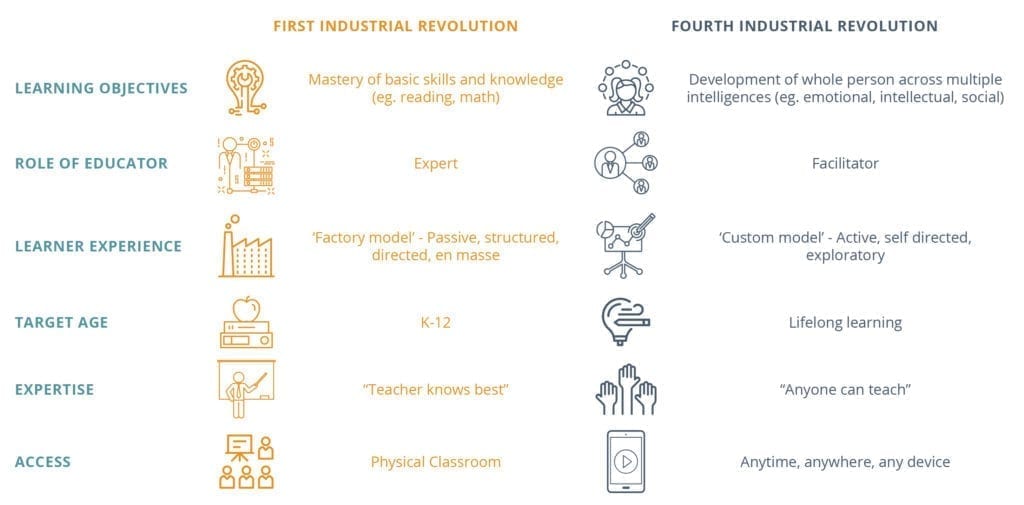
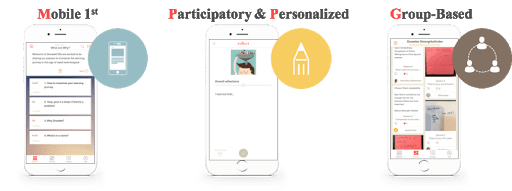
In order to scale these mindsets, we have no choice but to leverage technology to enable us to do this at scale and speed. Global unemployment among youth stands at 13% (3x higher than that of adults), according to the International Labour Organization. Time is of the essence. We need a new way of learning and teaching to develop the 4Cs. We call it MPPG: Mobile-first, Participatory, Personalized, Group-based learning.
Mobile-first design
Given that more than 44% of the world’s population owns a smartphone, how can we harness these devices to close the rapidly-growing skills gap and empower people to take greater ownership of their own education? With the number of mobile users now greater than that of PC users, we need to design with a learner in mind who is most likely not sitting at a desk but rather on the go. When designing for this mobile learner, we need content to be bite-sized, interesting, ‘swipeable’ and accessible anytime, anywhere. This is the power of mobile-first versus mobile-responsive learning.
Participatory
With the level of stimulation people have grown accustomed to, the need to invite co-creation and participation is a critical part of developing the 4Cs. Ultimately, education should invite people to participate in their learning experiences – not merely read articles or watch videos passively. When learners participate in their learning experience, it increases ownership of the learning, therefore increasing likelihood of its application, which is the true value of knowledge. Learners need to develop critical-thinking skills to reflect on the challenges they face in the Fourth Industrial Revolution.
Personalized
When given the same challenge, each of us will respond differently based on our backgrounds and experiences, so let’s evolve beyond using overly simplified multiple-choice assessments to test knowledge. In a world characterized by VUCA – volatility, uncertainty, complexity and ambiguity – we need to develop critical thinking and judgment skills so that each person is empowered to form their own opinions and perspectives. Learning must give space for individuals to provide their own answers, so that learning is personalized and relevant to different contexts. After listening to a lecture, people’s takeaways will vary, so let’s create space and time for personal reflection in learning.
Group-based
Deeper learning takes places when adults debate, discuss and learn from each other and share their knowledge and experiences. This is sometimes referred to as “social learning”. Embedding group-based learning into the fundamental architecture of education is essential to encouraging ‘sharing’ behaviours. Sharing and working in groups develops communication and collaboration skills.
We are living in more complex, uncertain, times in an age where humans and technology are learning how to interact with each other. We are running out of time to develop 21st-century skills and mindsets, and close the growing employability gaps. We need to adopt new perspectives and ways of developing skills at scale. Based on the latest available science of adult learning, MPPG provides a practical framework for moving us in the right direction.
Article first published as part of the World Economic Forum on ASEAN in September 2018

About the Author: So-Young Kang, Founder and Chief Executive Officer, Gnowbe
Founder of Awaken Group, author of Inside Out: Conversations about Leadership and Innovation in a New Global Economy, World Economic Forum Young Global Leader, formerly in leadership roles at McKinsey and Citigroup, MBA from Harvard Business School, BA from Univ of Pennsylvania. So-Young is a serial entrepreneur who wants to change the world by maximising the potential within people. This is her 2nd (if you don’t count her restaurant project in NY) start-up across the US and Asia. She builds businesses and organizations that have impact globally as she creates solutions that are borderless.
So-Young considers herself blessed to be in a community with the world’s leading thinkers from Harvard, University of Pennsylvania, TED, and as a Young Global Leader nominated by the World Economic Forum. She is an experienced entrepreneur, published author, global speaker and educator. She started teaching piano at age 11 and started her professional career teaching in Japan nearly 20 years ago before moving onto Citigroup and McKinsey & Company.