








The Road to Recovery
One Year On
Cast your mind back to a year ago this week. The Australian government had just imposed social distancing rules, having dropped an iron curtain around our borders. Meanwhile, state governments were putting a halt to non-essential services and corporate Australia was heading for the emergency exits with many companies asking their people to work from home.
The first reported case of COVID-19 in Australia had been two months earlier, but it was only in mid-March 2020 that the anxiety had spiked to an unprecedented high. Just think toilet paper rolls.
One year on, and Australia has become the global gold standard for its response to the pandemic. Vaccine rollouts have begun in earnest in a landscape of zero local transmissions. On the face of it, we should be bouncing back in leaps in bounds.
Yet, as we reported in our first blog about burnout, the emotional rollercoaster continues to take its toll on our general levels of wellbeing.
The general consensus from leaders in the corporate workplace is neatly summed up in this recent comment we heard from one of our clients:
“I feel tired all the time and I can’t work out what is wrong with me. I feel emotionally burnt out – so does everyone else around me. We just can’t work out what is wrong.”
Making Sense of it All
Researchers at the Kets de Vries Institute recently highlighted a model that helps make sense of this collective sense of emotional burnout.
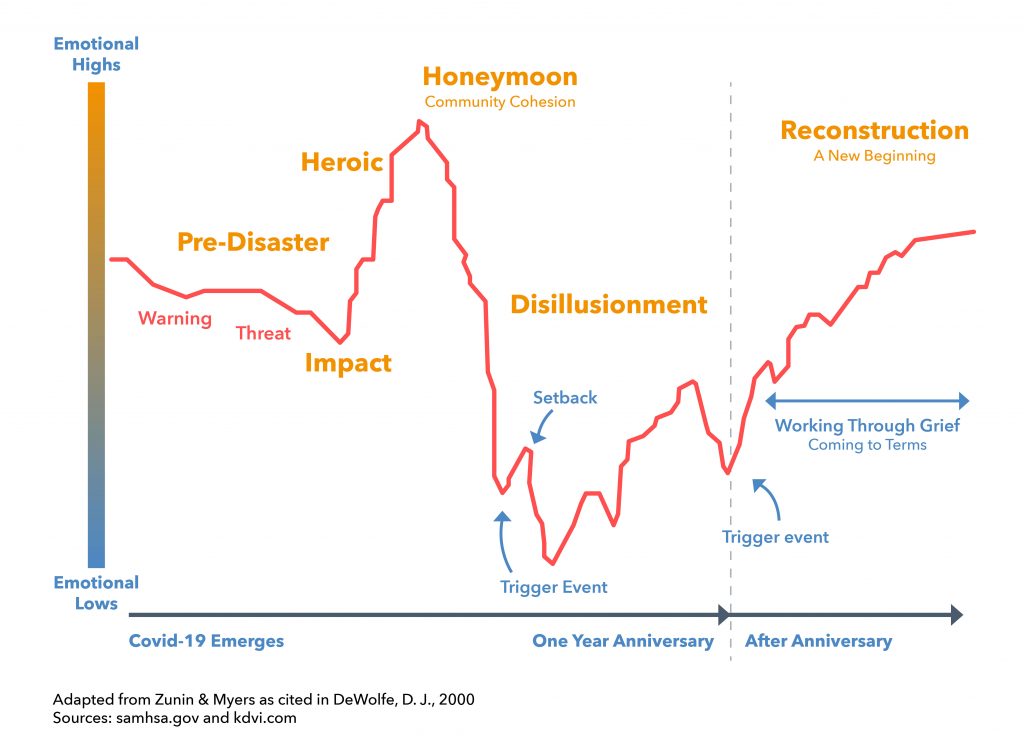
Originally developed over twenty years ago, Zunin and Myers Phases of Disaster model describes the collective emotional response leading up to, during and emerging from a disaster—in this case a global pandemic.
We believe it is an important model for all leaders because it provides a framework that helps people make sense of the seemingly irrational emotions that have been a product of this pandemic, and in part helps explain the general sense of burn out.
It also provides a useful roadmap that helps leaders normalise the remaining ups and downs that we are still likely to encounter – even as we recover.
To help navigate others through what lies ahead, it is important to understand the five phases that we have just passed through.
- The Pre-Disaster Phase. The spectre of a new coronavirus was looming large. The uncertainty generated fear and anxiety, which was then lessened by a false sense of security as case numbers rose globally without any impact here.
- The Impact Phase. Reality hit. A spike in case numbers and the subsequent lockdowns created a range of intense emotional reactions, including shock, panic, confusion and disbelief, followed by a focus on self-preservation and family protection.
- The Heroic Phase. The heroic phase is characterized by high levels of activity with low levels of productivity. There was a sense of altruism, collaboration and cooperation which led quickly to the next phase.
- The Honeymoon phase. There was a strong sense of optimism that everything would return to normal quickly. It led to a strong sense of community and a desire to help others.
- The Disillusionment phase. The honeymoon phase was short-lived as soon as it became apparent that there was no quick fix. False dawns (trigger events such as unrealistic vaccine hopes) were short-lived. A vaccine was reportedly a year away. Protracted lockdowns led to a sense of discouragement, negativity, and prolonged physical exhaustion.
Taking the foot off the Gas Pedal
So here we are, in the final phase of the Phases of Disaster model: Reconstruction. This phase is characterised by a sense of grounded optimism and future-focus.
However, it is important for leaders to understand that for their people to sustain the much-needed high levels of performance, many need to first rebuild their diminished energy reserves.
One of the reasons that the unrelenting emotional ups and downs of the pandemic have taken a physical toll on us is that it has been triggering our fight-flight response. This autonomic mechanism activates the sympathetic nervous system, providing the body with bursts of energy so that it can respond to perceived dangers. It is a bit like putting your foot on the gas pedal.
Usually, after the danger has passed, the parasympathetic nervous system kicks in, putting the brakes on and promoting the “rest and digest” response that calms the body down.
However, research shows that over periods of sustained threat (like the one we have just been through), the body stays revved-up, continually producing stress hormones which deplete the body’s reserves of energies.
In other words, we have finally taken our foot off the pedal, but we are running on empty.
“We have finally taken our foot off the gas pedal, but we are running on empty.”
Navigating the Final Phase
For Board members, Executives and Senior Leaders looking to mitigate the effects of burnout in the recovery phase, we recommend a three-step approach.
- Build Awareness and Understanding of the Problem
In Part One of this two-part series on Burnout, Putting Burnout in the Crosshairs we focused on the importance of getting to the true sources of burnout – rather than just the symptoms. The point that we underscored is that leaders need to take a whole-of-organisation approach that considers resourcing, systems, structures and processes as well as the huge range in people’s capacity to manage ongoing stress. An off-the-shelf approach is at best a band-aid solution. For some organisations it will also mean a cultural shift that de-stigmatises burnout.
- Bring Underlying Issues to the Surface
While it is important to look beyond the symptoms of burnout, it is just as important for leaders at every level of an organisation to learn how to spot the early indicators of burnout and the red flags. You can download our worksheet on the subject here: Questions-to-inspire-endurance-and-motivation.
- Provide Validated Solutions and Support
We saw organisations provide consistent and generous wellbeing support to their people in the immediate aftermath of the pandemic. Now that we are in the recovery phase, it might be tempting to de-prioritise these initiatives. However, what the Phases of Disaster model implies is that at the human level, our recovery is still fragile. Therefore scientifically validated, world-class support, like that provided by our colleagues at Alchemy is crucial.
In some ways, investing in your people, communicating with them prolifically and empathetically, creating forums for people to share their concerns, and learn new skills for self-care is more important now than it was a year ago — when our adrenalin-induced responses seemed to carry us through.